

"Bangkok condos are over supply!" is a line most people have heard plenty of times by now. According to Knight Frank Thailand's latest quarterly report, unsold inventory across Bangkok's condominium market is nearing 350,000 units. At the current pace of sales, it would take five to six years to clear that backlog, and not a single new project launched in the CBD core in the first quarter. That claim holds up under the data. What rarely gets mentioned is that the same city has another market almost nobody reports on, one that global UHNIs (ultra high net worth individuals) have been quietly stockpiling.
According to CBRE Thailand's latest figures, completed luxury and super luxury projects in downtown Bangkok reached cumulative sales rates of 95% and 86% respectively in Q1 2026. Pre-completion projects weren't far behind, at 72% and 82%. The buyer profile is just as telling: CBRE reports that in core submarkets like Sukhumvit and Silom-Sathorn, roughly 73% of buyers are purchasing for their own use, versus 27% for investment.
In other words, "Bangkok real estate" describes two different things at once. One market is working through a glut of unsold stock. The other, where global UHNIs are quietly adding to their holdings, is a market that gets flattened out and lost inside the broad, aggregate numbers.
Two Bangkoks: One Working Through Inventory, One Running Short of Supply
Start with the broader market. Knight Frank Thailand's Q1 2026 report shows 58% of new supply concentrated in the city fringe and 42% in the suburbs, with 68% of new launches priced below THB 80,000 per sqm, aimed squarely at first time buyers and mid to lower price point demand. The average asking price in the CBD sits around THB 236,800 per sqm, and even that is under some pressure as upper end demand slows.
This is the "Bangkok oversupply" story most people know. But it's a story playing out in the mid to lower price bands, the suburbs and the city fringe, not in the luxury market at the CBD core.
Now look at the luxury end. Both Colliers and JLL's Q1 2026 reports point to overall take up recovering to 71.7%, with demand strongest in the luxury and upper end segments, particularly projects in prime locations priced competitively. Foreign buyer interest in new launches has clearly picked back up, with some projects nearing their foreign ownership quota. JLL data shows rents for high end and luxury condos in Bangkok rose 5.1% year on year in Q1 2026, with yields ticking up slightly to 5.4%. Savills describes the ultra luxury segment, priced above THB 350,000 per sqm, as a "safe haven" for global HNWIs, noting that assets in prime addresses like Thonglor and Sathorn are increasingly treated as wealth preservation tools. Its outlook for 2026 points to a "flight to quality" that splits the market further apart.
Four separate research houses are describing the same thing: Bangkok real estate isn't declining across the board. It's splitting into two clearly different worlds, one in the core luxury market and one across the broader city.
Why UHNI Buyers Are Owner Occupiers, Not Just Investors
That 73/27 split between owner occupiers and investors points to a few specific things actually driving this group of buyers.
Lifestyle, education and healthcare. Bangkok combines one of Southeast Asia's densest networks of international schools with world class healthcare. On the education side, Bangkok Patana School, NIST International School, Shrewsbury International School and Harrow International School Bangkok are consistently ranked among the city's leading international schools, offering IB or British curricula with strong track records of placing students into top universities in the US and UK. On the medical side, Bumrungrad International Hospital is one of Southeast Asia's largest private hospitals, treating more than 1.1 million patients from over 190 countries each year, and has been repeatedly ranked among the world's leading medical institutions by Newsweek and the Wall Street Journal. Add JCI accredited hospitals like Samitivej and Bangkok Hospital, and the cost of comparable care typically runs at 30% to 50% of what it would cost in Europe or the US. For high net worth families relocating with children, this combination of schools, healthcare and everyday convenience in one place is hard to find anywhere else in the region.
The independence that comes with ownership. Rather than renting for a decade, buying gives owners a home they can actually design and renovate on their own terms, without the risk of a landlord reclaiming the unit, renovating it, or raising the rent and forcing a move. For families settling in Bangkok long term, owning the property is as much about stability and control over their own living situation as it is about asset allocation.
Long term residency and the tax incentive behind it. Thailand's Long Term Resident (LTR) visa is one of the few residency pathways designed explicitly for high net worth individuals. Under the Wealthy Global Citizen category, applicants need at least USD 1 million in personal assets and must invest at least USD 500,000 in Thai government bonds, direct investment in a Thai company, or Thai property, in exchange for a renewable 10 year residency with no minimum income requirement. The real draw is the tax treatment: foreign sourced income that LTR holders remit into Thailand is exempt from Thai personal income tax, one of the only visa categories in the country that offers this explicitly. For buyers looking at Bangkok as a second home while keeping their income structured overseas, that tax incentive often matters more than the price of the property itself.
Case Study: Scope Langsuan, a Ceiling Price Built on Land Scarcity
Scope Langsuan sits at the junction of Langsuan and Ploenchit, on one of the last freehold plots remaining in Bangkok's city center. Developed by Scope Company Limited in partnership with SC Asset, the single 34 storey tower holds only around 158 units and was completed in 2023. The architecture comes from Kohn Pedersen Fox (KPF), with interiors by Danish designer Thomas Juul-Hansen, and that pairing of international firms is itself a form of quality assurance.
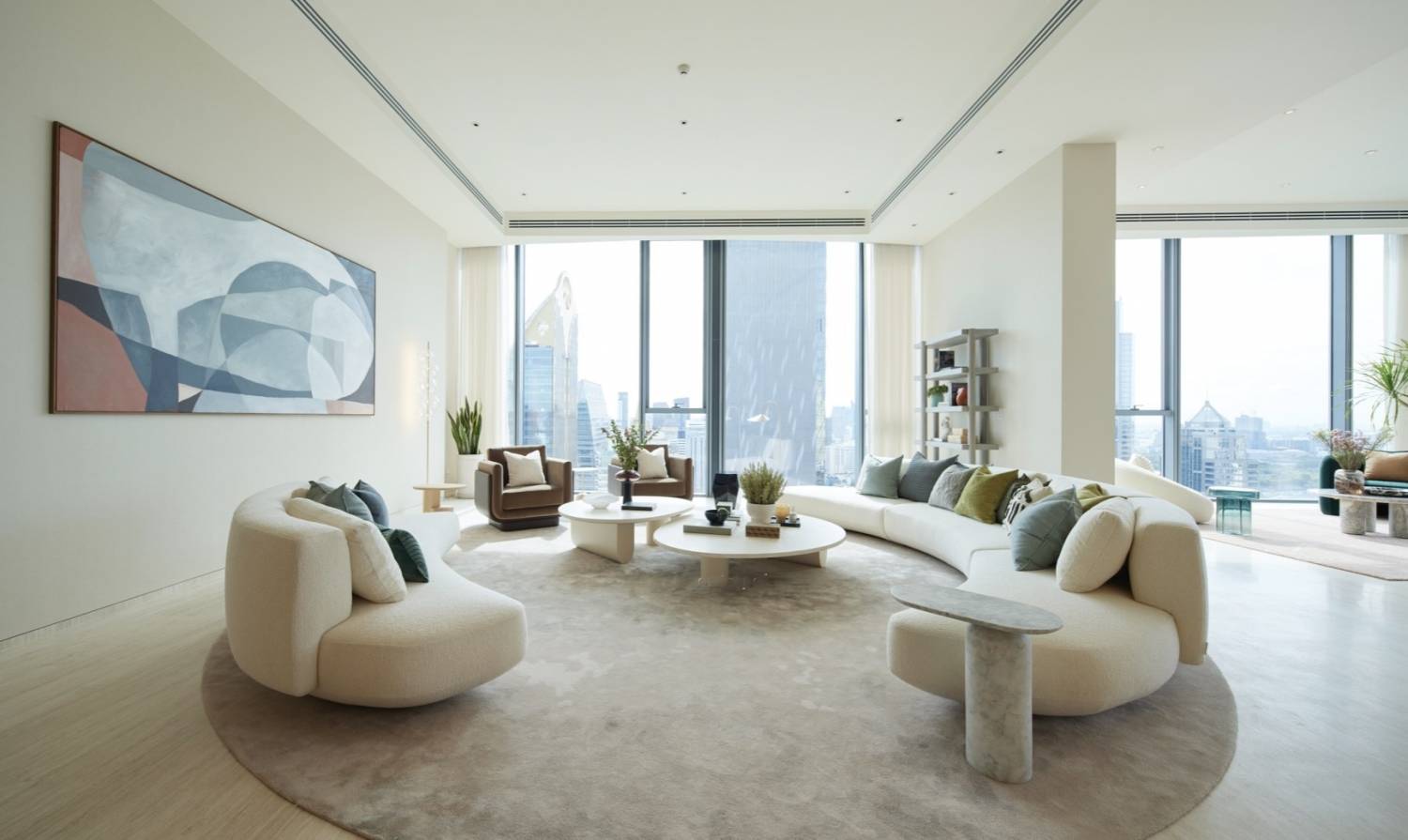
At the end of 2024, Scope Langsuan publicly announced it had set a new record for price per square metre in Bangkok, with average pricing between THB 700,000 and 780,000 per sqm and total unit prices ranging from THB 35 million to THB 137 million, several times the average for both Pathum Wan district and Bangkok as a whole. The market has absorbed that price largely because of land scarcity. Developable freehold plots in Langsuan are essentially gone, and this tower is likely one of the last of its kind in the area.
The building's amenities are built around the same buyer profile: roughly 2,500 sqm of clubhouse space, a temperature controlled marble pool, a private cinema with Dolby Atmos sound, a mechanical valet parking system running at about 145% capacity, and a dedicated dog park. Pet friendliness is close to a non negotiable for this buyer group rather than a nice to have. On location, the tower is a short walk to BTS Chidlom, surrounded by Central Chidlom, CentralWorld, Siam Paragon, Central Embassy, Gaysorn Village and Lumpini Park. The lifestyle convenience here is just as hard to replicate as the scarcity of the land itself.
Since Thailand has no centralized database of transaction prices, working with a local agent who can benchmark past sales, help negotiate and manage title due diligence becomes an important part of reducing risk for foreign buyers.
The Takeaway: Know Which Bangkok You're Actually Buying
"Bangkok real estate is declining" and "global UHNIs are still quietly stockpiling Bangkok" are both true at the same time. The difference is which market you're actually looking at. The broader market is genuinely under pressure, but freehold luxury property in the core CBD, with limited supply, steady sales and buyers who are mostly living in what they buy, follows a completely different logic. It's also the part of the market most easily lost in the headlines, and the part most worth taking seriously.
📩 To learn more, please reach out to Upper Estates:
Which freehold luxury developments in Bangkok's core CBD are currently selling
A resale market comparison between Scope Langsuan and other projects along the Langsuan and Sathorn corridors
LTR visa eligibility and the real estate investment thresholds involved
The foreign buyer purchase process, title due diligence and local negotiation support
We offer trilingual one on one consultations in Mandarin, English and Thai to help you work out which Bangkok is actually worth buying into.