

If you have been following Bangkok's real estate market over the past twelve months, one pattern is impossible to miss: ultra-luxury residential projects are launching one after another, at a pace the market has never seen before.
This is not market overheating.
It is not coincidence.
It is a structural repositioning that has been building for years , and it is happening now for very specific reasons.
This article examines the background, the logic, and the risks behind Bangkok's 2026 ultra-luxury surge.
I. The Projects: What Has Actually Launched
Before asking why, it is worth being precise about what we are talking about.
Upper House Residences Bangkok: Developed by Swire Properties and City Realty, with architecture by Foster + Partners, the project spans two towers totalling 395 residences on a rare freehold site directly fronting Lumpini Park on Wireless Road. This is the world's first Upper House branded residence, the flagship Hong Kong luxury hospitality brand making its residential debut in Bangkok. Expected completion: 2029–2030.
STILL Sukhumvit 20: A joint venture between SC Asset and Tokyo Tatemono, with 124 units valued at approximately THB 6 billion. Positioned as an ultra-low-density luxury residence in the Sukhumvit corridor, the project has now reached over 80% sold. For a development where individual units start in the tens of millions of baht, this figure is extraordinary, and it directly challenges the narrative of a "crashing" Bangkok property market. What it actually demonstrates is a market that has bifurcated cleanly: mass-market commodity condos struggle, while the right product in the right location continues to perform.
InterContinental Residences Bangkok Asoke: Developed by CG Capital (Central Group's investment arm) in partnership with IHG, this 88-unit freehold project on Sukhumvit Soi 16 achieved over 50% sales at its VIP pre-launch event in November 2025. It is the first standalone branded residence ever launched under the InterContinental name globally, a milestone that reflects both IHG's confidence in the Bangkok market and the depth of demand for internationally-backed luxury assets.
Scope Thonglor: Already completed and handed over. At 32 storeys with just 18 units — every single one a penthouse, and with individual floor areas starting from 415 sqm, Scope Thonglor represents one of the most extreme exercises in residential scarcity Bangkok has ever produced. Notably, it achieves this without a hotel brand or international developer backing. The project proves that in the ultra-luxury tier, spatial scarcity and design integrity can be just as powerful a value proposition as brand equity.
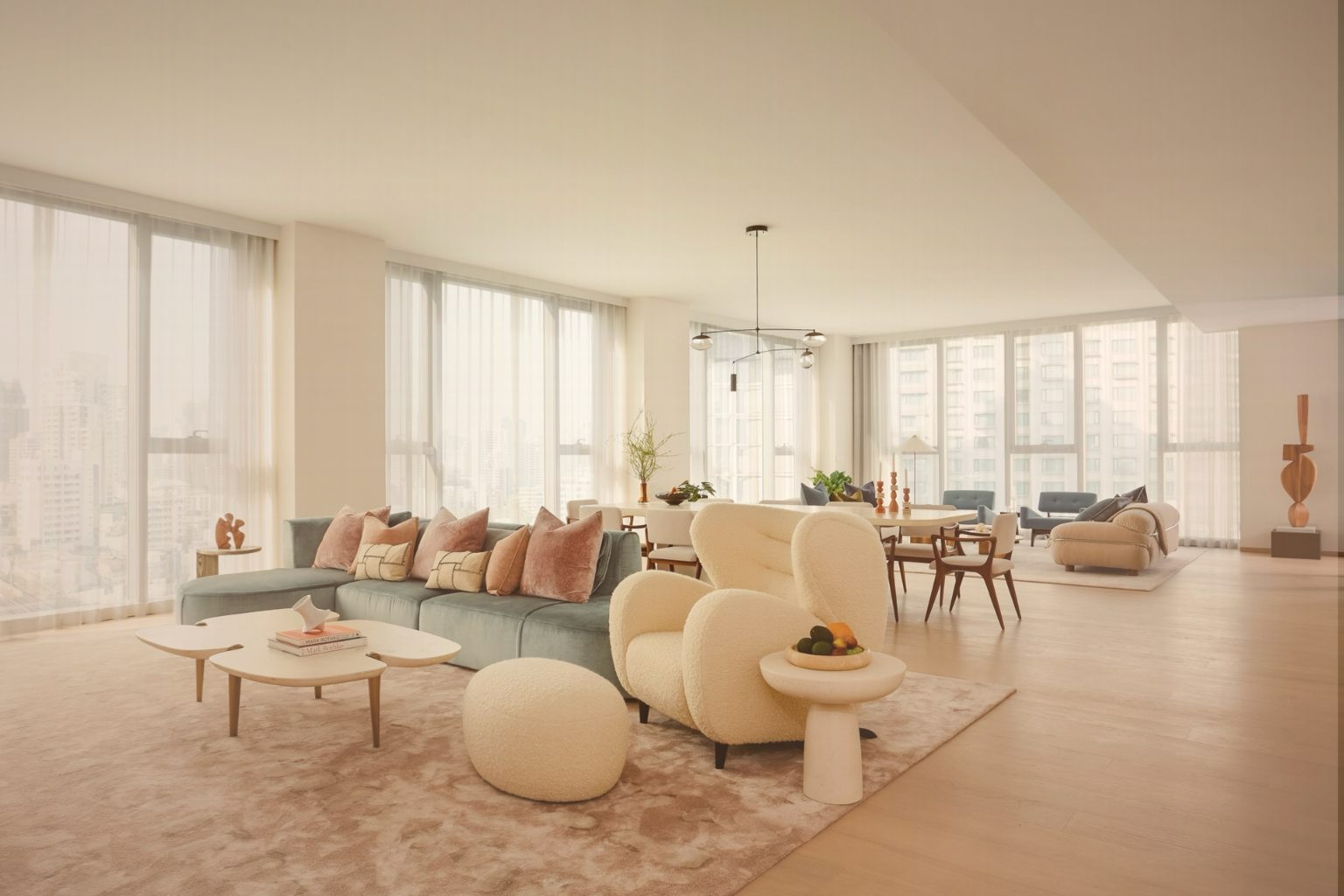
The Monument Sathorn One of the most anticipated upcoming launches in Bangkok's luxury market. EIA approval has been secured and the project is expected to open for sale in mid-2026. Located on Sathorn Soi 10, approximately 80 meters from BTS Saint Louis, the development comprises 29 floors and only 185 units, with flat parking bays and a pet-friendly policy that are increasingly rare in the inner city.
SC Asset Rama IV — All Penthouse Development by SC Asset is planning an all-penthouse product on a prime freehold site directly opposite Lumpini Park on Rama IV Road, formerly the site of the Srifuengfoong Building. With reported starting prices of THB 150 million per unit, this will be among the highest-priced residential launches in Bangkok's history when it comes to market. The site is one of the last first-row park-frontage land plots available for development in the inner city.
II. Why Now? Four Structural Drivers
1. Mid-Market Slowdown Forces Developers Upmarket
Bangkok's mid-range residential market has faced sustained pressure over the past two years. Bank loan rejection rates remain elevated, overall demand has moderated, and developers have become more cautious about launching commodity-grade product.
But the logic at the top of the market is entirely different. Ultra-high-net-worth buyers do not depend on leverage. Their decision-making is driven by scarcity, brand value, and long-term capital preservation, not monthly repayment pressure or mortgage eligibility.
This created a rational strategic response from developers with the land and capital to act: concentrate resources on the most defensible, highest-value products in the most irreplaceable locations. Abandon volume. Pursue quality.
The result is a supply structure that has shifted decisively toward Ultra Luxury, not as a speculative bet, but as a deliberate strategy to avoid mid-market pressure while capturing the last available prime land before it disappears permanently.
2. Branded Residences Have Reached Critical Mass
Thailand currently ranks fourth globally by the number of branded residential developments — completed and in the pipeline. Both Phuket and Bangkok rank individually within the world's top ten cities for branded residences.
The brands entering Bangkok in this cycle — Upper House (Swire), InterContinental (IHG) , and more, are not regional names. These are hospitality brands that, until recently, reserved their residential extensions exclusively for global gateway cities: Hong Kong, London, Singapore, New York. Their decision to launch in Bangkok is itself a market signal: they have concluded that Bangkok now has the buyer depth and asset credentials to support these brands at the prices required.
The trust premium that a global brand provides is real and measurable. In an environment of market uncertainty, branded residences offer buyers a form of derisking that goes beyond the physical asset, because the brand's global reputation is implicitly attached to the long-term performance and management of the building.
3. International Developers Are Setting the New Standard
What distinguishes this cycle from previous luxury launches in Bangkok is the calibre of the developers involved.
Swire Properties (Hong Kong): One of Asia's most respected long-cycle city-makers. Its track record includes Pacific Place and Taikoo Place in Hong Kong, and EDEN in Singapore. Swire does not build for quick exits. It builds 30–50-year landmark assets, which is exactly the developer DNA that Wireless Road's most irreplaceable site demands.
Tokyo Tatemono: A Japanese developer known for precision product planning and exceptional build quality. Its entry into the Thai market is not opportunistic — it is the result of a deliberate long-term strategy targeting Bangkok's ability to sustain luxury demand.
IHG: The world's largest hotel company by number of hotels. Choosing Bangkok for the global debut of its InterContinental branded residences is an unambiguous vote of confidence in the market's maturity and buyer quality.
These partners bring not just capital, but international design standards, global brand infrastructure, and access to a buyer network that is genuinely global in scope. That is why this cycle's pricing has moved to levels that would have seemed unreachable in Bangkok just five years ago.
4. The Last Window on Prime Land
The supply of developable land in Bangkok's core inner city locations is approaching functional exhaustion.
Along Wireless Road, around Langsuan, and opposite Lumpini Park, prime sites have been absorbed steadily over the past three years. Every time a core site is developed, the remaining supply becomes more scarce, and the price floor for what remains rises accordingly.
III. Why Is It All Happening in 2026? Earthquake, Pent-Up Supply and Dubai Capital
The concentration of launches in 2026 specifically has a structural explanation that goes beyond long-term trend lines, and one that most market commentators have underweighted.
The 2025 Myanmar Earthquake Created a Release Valve
In late March 2025, a 7.7-magnitude earthquake struck Myanmar, sending shockwaves that were felt across Bangkok. Several high-rise buildings experienced significant movement, and building safety became, overnight, the most sensitive topic in Bangkok's real estate conversation.
Market confidence was disrupted. Multiple developers with projects already in advanced planning stages chose to delay their launch timelines, waiting for sentiment to stabilize before bringing high priced luxury product to market.
The result was a compression effect: launch momentum that had been distributed across 2025 was pushed forward and concentrated into 2026.
The projects that are hitting the market this year did not all originate this year. Many of them were ready earlier, held back by the earthquake's aftermath, and are now landing together. This explains why the density of ultra-luxury launches in 2026 has exceeded most market expectations — it is partly structural trend, and partly the release of a year's worth of pent-up supply arriving simultaneously.
But pent-up supply only creates a successful market if the demand side is there to absorb it. And that is where the Dubai capital story becomes essential.
Dubai Capital Reallocation: How Middle East Geopolitics Is Flowing Into Bangkok
Throughout 2026, escalating Middle East tensions — particularly those involving Iran, prompted a meaningful shift in how high-net-worth capital held in Dubai was being allocated.
Dubai has served, over the past several years, as the primary asset conversion and redistribution hub for capital originating from Russia, Iran, Central Asia, and other politically sensitive sources. As geopolitical risk began to press closer to the UAE itself, a segment of sophisticated asset holders began identifying their next port of call: a secondary safe haven location with political neutrality, favourable tax treatment, strong infrastructure, and a track record of welcoming foreign capital.
Bangkok checks every single one of those criteria.
The capital flowing from this source carries a very specific profile that aligns almost perfectly with what Bangkok's current Ultra Luxury pipeline is offering:
Scale and speed: These buyers do not negotiate on price for months. They make decisions quickly, often in cash.
Clear product preferences: Freehold ownership, branded management, low unit counts, large floor areas, exactly the specifications that define every project in this cycle.
No dependency on local financing: The Thai banking system's elevated loan rejection rates, which have suppressed mid-range market activity are simply irrelevant to these buyers.
The convergence of pent up developer supply from the post-earthquake delay and the arrival of externally driven capital demand in the same window is not a coincidence of good fortune. It is a structural alignment that explains both why so many projects have launched this year and why so many of them are selling at a pace that surprises the broader market.
IV. What Could Go Wrong? Honest Risk Assessment
Intellectual honesty requires acknowledging that a cycle this concentrated carries specific risks.
Synchronised Completion Pressure Multiple Ultra Luxury projects are targeting the 2029–2030 delivery window. While each targets a slightly different buyer profile, the rental market will face a period of simultaneous premium supply absorption. Rental yield compression in the short-to-medium term post-completion is a plausible scenario that buyers should factor into return projections.
The Limits of Market Depth Bangkok's universe of qualified buyers for THB 50M+ residential assets is real but finite. Multiple projects competing for the same pool simultaneously will produce clear winners, projects with the strongest brand, the most irreplaceable location, or the most differentiated product, and clear laggards. Identifying which projects occupy which position is the most important analytical task for any buyer in this market right now.
Cross-Border Complexity for International Buyers International buyers entering Bangkok's luxury market through foreign-developer branded residences face a more complex tax and legal structure than domestic transactions. Transfer taxes, withholding tax treatment for offshore capital flows, and the mechanics of Freehold title for foreign nationals all require careful advance planning with qualified Thai legal counsel.
Conclusion: 2026 Is the Year of Opportunity and the Year Where Judgment Matters Most
Bangkok has arrived on the global stage as a serious contender in the ultra-luxury residential market. This year's launch density is the clearest evidence yet that the city has earned its place alongside Singapore, Dubai, and Hong Kong as a destination for globally mobile, brand-conscious, asset-preservation-focused capital.
The opportunity is real. So is the complexity.
In a market with this many compelling products launching simultaneously, the question is not whether Bangkok is worth investing in. The question is: which project is the right fit for your specific asset strategy, timeline, and lifestyle priorities?
That is a question worth spending serious time answering before committing.
Upper Estates provides one-on-one advisory in English, Mandarin, and Thai, helping clients navigate this market with the depth of local knowledge and the objectivity of independent counsel.